Cash Buyer Buy Box: What It Is, What to Track, and How to Match Wholesale Deals
A cash buyer buy box defines the properties an investor actually wants. Learn what criteria wholesalers should track, how to confirm the box with purchase activity, and how to match each wholesale deal to the right buyers.

Contents
A cash buyer buy box is the set of criteria an investor uses to decide which real estate deals they want to review or buy.
For a wholesaler, it answers a more useful question than "Who is on my buyer list?"
It answers: Which buyers are a plausible fit for this specific property, at this price, in this condition, with this exit strategy?
A practical real estate investor buy box usually covers location, property type, purchase-price range, size, bed and bath count, age, rehab tolerance, strategy, return requirements, deal-breakers, and closing preferences. The exact criteria vary by buyer, and a match does not guarantee that the investor has funds or will close.
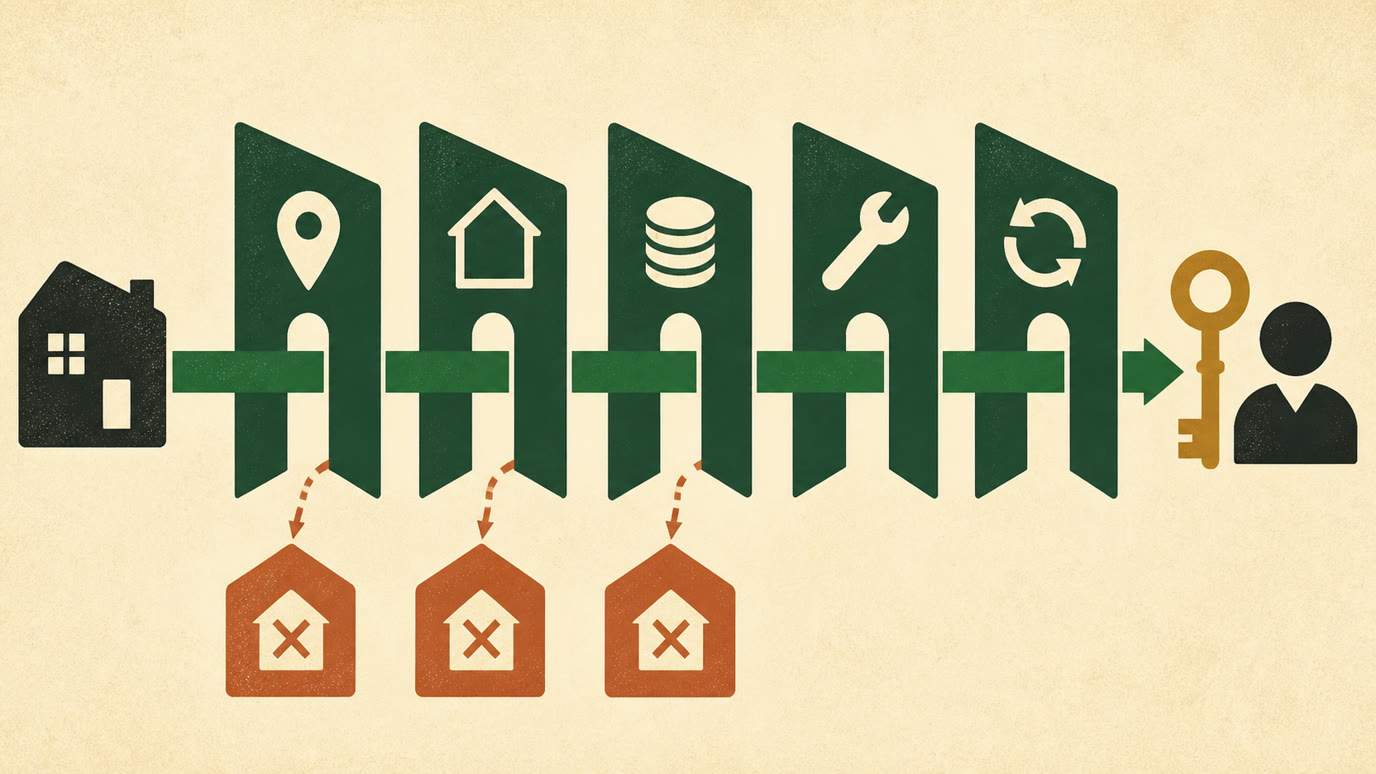
The Short Version: How Wholesalers Use a Buyer Buy Box
Use this workflow when you have a wholesale deal to disposition:
- Define the deal clearly: location, property type, physical facts, condition, rehab, price, and likely strategy.
- Filter on firm criteria first: remove buyers whose stated location, price, property type, or non-negotiable deal-breakers do not fit.
- Check strategy and economics: decide whether the deal is more likely to fit a flipper, landlord, BRRRR buyer, wholetail buyer, or another investor profile.
- Compare with observed activity: when reliable purchase history is available, look for relevant recent transactions rather than relying only on what a buyer said months ago.
- Contact the best-fit buyers first: personalize the outreach around concrete property fit, not an internal score or a generic blast.
- Verify transaction readiness separately: confirm identity, funding evidence, due diligence, earnest money, title, and closing expectations before treating an offer as secure.
The result is not a smaller buyer list. It is a buyer list with enough context to be useful.
What Does "Buy Box" Mean in Real Estate?
In real estate investing, a buy box is a written or understood description of the opportunities an investor is prepared to pursue.
Instead of saying, "Send me anything in Memphis," a buyer with a useful box might say:
I am looking for single-family rentals in specific Memphis ZIP codes, within a defined all-in basis, with manageable renovation needs and a layout that fits my tenant profile. I can close on an agreed timeline after reviewing title, access, and the property condition.
That still needs more detail, but it gives the wholesaler a starting point.
A buy box is not the same as a guaranteed offer. It is a screening framework. The investor still has to underwrite the actual property, review the transaction, and decide whether the current opportunity deserves their capital.
The 10 Criteria Every Cash Buyer Buy Box Should Track
1. Target Location
Location can be as broad as a market or as narrow as a group of neighborhoods, ZIP codes, school zones, or streets. Ask what boundaries are firm and what locations the buyer will consider only at a stronger basis.
Do not reduce location to a city name. A buyer who owns rentals in one part of a city may avoid another part because the rent, property management, taxes, insurance, resale demand, or operating model differs.
2. Investment Strategy
Identify what the buyer intends to do with the property:
- fix and flip
- buy and hold
- BRRRR
- wholetail
- short- or medium-term rental, where appropriate
- another clearly defined strategy
The same house can produce different maximum prices for different strategies. A flipper works backward from resale value and project costs. A landlord focuses on income and total basis. A BRRRR buyer also needs the renovation, rental, and refinance constraints to work together.
Read How Cash Buyers Underwrite Wholesale Deals for the differences.
3. Property Type
Track whether the buyer wants detached single-family homes, townhomes, condos, small multifamily properties, manufactured housing, land, or another category.
Property type is often a firm filter. A landlord who operates three-bedroom houses may not want a duplex. A flipper who understands older urban homes may not want a rural manufactured property, even if the headline margin looks attractive.
4. Purchase Price and Total Basis
Ask for the buyer's acquisition-price range, but do not stop there.
Many investors care more about total basis: purchase price plus repairs, closing and financing costs, and other capital required to execute the plan. A buyer may accept a higher purchase price for a clean property and require a lower one for a heavy renovation.
For wholesalers, the buyer's maximum price also needs to accommodate the assignment fee. Use the complete framework in the Wholesale Real Estate MAO Calculator.
5. Beds, Baths, Size, Age, and Layout
Physical criteria help distinguish a theoretical deal from a property the investor can actually operate or resell.
Track the buyer's ranges for:
- bedrooms and bathrooms
- square footage
- year built or construction era
- lot size, parking, basement, garage, or other market-specific features
- functional layout and major additions
Record which items are requirements and which are preferences. A three-bedroom minimum may be firm for one landlord and flexible for a flipper buying below a certain basis.
6. Condition and Rehab Tolerance
"Needs work" is not specific enough.
Ask what the buyer will and will not take on:
- cosmetic interior updates
- kitchen and bath replacement
- roof or mechanical systems
- fire, water, or mold damage
- foundation or structural work
- occupied properties, cleanout, or access constraints
- permits or complex renovation scope
A buyer with the capital to close may still reject a deal outside their operational capacity. Rehab tolerance is as much about team and timeline as money.
If the condition is still uncertain, use an itemized first pass and clearly identify what needs verification. See AI Rehab Cost Estimator for Real Estate Investors.
7. Return Requirements
The buy box should identify what makes the deal financially worthwhile to that buyer.
Depending on strategy, that may include target profit, cap rate, cash flow, cash-on-cash return, debt-service coverage, equity left in a BRRRR deal, or another buyer-specific threshold.
Do not turn a buyer's preferred return into a universal market rule. Use it to understand why the buyer can or cannot pay your asking price.
8. Deal-Breakers
Deal-breakers are conditions that cause a buyer to pass regardless of the apparent spread.
Examples may include certain locations, flood exposure, foundation risk, unpermitted additions, an HOA, tenant or access complications, title issues, septic systems, or property types outside the buyer's experience. The list will vary substantially by buyer and market.
Ask for deal-breakers directly. They are often more useful than a long list of preferences.
9. Funding and Due-Diligence Path
A buy box should record how the buyer generally approaches transactions: cash on hand, a lending relationship, private capital, partnership approval, or another funding path.
It should also capture practical due-diligence needs:
- walkthrough or inspection expectations
- required property photos and documents
- earnest-money process
- decision-maker and purchasing entity
- title-company or closing-attorney coordination
This information helps you prepare the deal, but it is not transaction-specific proof of funds.
10. Closing Timeline and Communication
Track how quickly the buyer can inspect, decide, deposit earnest money, and close when the deal fits. Also record the best contact method and who has authority to make the decision.
Fast communication is helpful. A realistic, repeatable closing process is more valuable.
Stated Buy Box vs. Observed Buy Box
Wholesalers should use two forms of buyer evidence.
| Evidence | What it tells you | Limitation |
|---|---|---|
| Stated buy box | What the buyer says they want now | Can become stale, broad, or aspirational |
| Observed buy box | What relevant purchase history suggests they have actually bought | Past activity may not reflect current capital or strategy |
Neither one is automatically correct by itself.
If a buyer says they want heavy-rehab flips but their recent purchases are stabilized rentals, ask a follow-up question. They may be entering a new strategy, buying through another entity, or describing a preference they have not acted on yet.
If transaction history shows a clear pattern but the buyer tells you their criteria changed last week, use the current conversation and update your records. The goal is not to prove the buyer wrong. It is to avoid presenting old assumptions as current fact.
Cash Buyer Buy Box Example
Here is a hypothetical buy box for a rental investor:
| Criterion | Example |
|---|---|
| Location | Selected ZIP codes and neighborhoods in one operating market |
| Strategy | Buy and hold, with BRRRR considered when refinance math works |
| Property type | Detached single-family homes |
| Layout | 3+ bedrooms, functional rental layout |
| Purchase range | Set per total basis and supported rent, not a universal ceiling |
| Rehab tolerance | Cosmetic to moderate; major structural work excluded |
| Returns | Minimum cash flow and coverage requirements after realistic expenses |
| Deal-breakers | Defined property, title, access, and location risks |
| Closing | Timeline subject to walkthrough, funds review, and title process |
Now imagine a two-bedroom heavy-rehab property outside the target area. A deep discount does not automatically turn it into a match. The investor may lack the operating team, tenant demand, or strategy for that house.
A buyer who is active nearby but outside one preference may still deserve a call. A buyer who misses multiple firm criteria should not be your first call just because their email is on the list.
How to Ask a Cash Buyer for Their Buy Box
Use questions that produce operational answers:
- Which markets, ZIP codes, or neighborhoods are you actively buying in now?
- What exit strategies are you using in each area?
- Which property types and physical ranges fit?
- How do you set your maximum purchase price or all-in basis?
- What level of renovation can your team handle?
- What are your automatic deal-breakers?
- What documentation do you need to make a decision?
- Who approves the purchase, and which entity typically closes?
- How quickly can you inspect, deposit, and close when a deal fits?
- When should I check back to confirm your criteria are still current?
Avoid asking only, "What's your buy box?" Broad questions often produce broad answers. A structured conversation creates information you can actually use in disposition.
How to Match a Wholesale Deal to the Right Buyers
Start With the Deal, Not the List
Before selecting buyers, make sure the property package is credible. Review the sold comps supporting ARV, the repair scope, the likely buyer strategy, the asking price, and material unknowns.
If the deal is overpriced or the condition story is weak, better targeting will not fix it. Use How to Run Comps for Wholesale Real Estate and How to Tell If a Wholesale Deal Will Sell first.
Apply Firm Filters
Remove buyers whose non-negotiable location, property type, price, or condition criteria clearly exclude the deal. Missing data should not be treated as proof of fit; it is a reason to confirm the criteria.
Rank With Relevant Activity
Among the remaining buyers, prioritize people or entities with relevant activity where that information is available. Look at similarity, proximity, recency, price band, and strategy context together.
One nearby purchase does not guarantee interest. A consistent pattern can give you a stronger reason to call that buyer first.
Personalize the Outreach
Lead with facts the buyer cares about: location, property type, asking price, condition, rehab assumptions, and why the deal appears relevant to their strategy.
Do not tell a buyer they received an internal match score or that you have profiled them. The useful message is concrete: "You have been active in this area and this property fits the rental profile you described."
For the full package and outreach sequence, read How to Market a Wholesale Deal to Cash Buyers.
Keep Backup Buyers Warm
Buy-box matching improves prioritization. It should not make you dependent on one person.
Keep a short second group of qualified buyers who fit most of the deal and can step in if the first buyer passes, changes terms, or misses a transaction milestone.
Buy-Box Fit Is Not Buyer Verification
A matching buy box tells you the property may be relevant. It does not prove that the buyer:
- controls the purchasing entity
- has sufficient funds for this transaction
- accepts your ARV or rehab assumptions
- will complete due diligence on schedule
- will deposit earnest money or close
- meets title, contract, or settlement requirements
Treat fit and readiness as separate checks. Once a buyer engages, follow the process in How to Verify a Cash Buyer for a Wholesale Deal.
How Rehouzd Uses Buyer Fit in Disposition
Rehouzd helps wholesalers move from a property analysis to a more relevant buyer shortlist. The workflow can combine property facts, strategy context, buyer-profile criteria, and available activity signals so you can narrow buyers by fields such as price, bedrooms, bathrooms, square footage, and property age, then review the buyer before adding them to outreach.
The purpose is prioritization, not certainty. A match helps answer who is worth contacting first. The wholesaler still needs to verify the property assumptions, confirm the buyer's current criteria, and complete transaction-specific funding and closing checks.
This is the practical difference between a database and wholesale dispo software: a database stores contacts; a dispo workflow connects the deal, the likely strategy, buyer evidence, outreach, and follow-through.
The Bottom Line
A buyer list tells you who you can contact. A cash buyer buy box helps you decide who you should contact first.
Track the criteria that shape the buyer's actual decision. Compare stated preferences with relevant activity. Keep the deal analysis honest. Then verify funding and closing readiness when a buyer engages.
That is how wholesalers turn buyer matching into a repeatable disposition process instead of another mass email. Run a property analysis and find relevant buyers in Rehouzd.
Frequently Asked Questions
What is a cash buyer buy box?
A cash buyer buy box is the set of criteria an investor uses to decide which properties they want to review or purchase. It commonly includes location, property type, acquisition price, size, bed and bath count, age, condition or rehab tolerance, investment strategy, return requirements, and closing preferences.
What should a wholesaler include in a buyer buy box?
Track the buyer's target markets, property types, price range, physical-property ranges, rehab tolerance, exit strategy, required returns, deal-breakers, funding path, due-diligence needs, and preferred closing timeline. Record which criteria are firm and which are flexible.
How do you find a cash buyer's buy box?
Ask the buyer directly, then compare their answers with relevant recent purchases when that evidence is available. A stated preference and an observed purchase pattern can differ, so confirm which criteria apply to the deal you are marketing now.
Does a buy-box match mean a cash buyer is verified?
No. Buy-box fit indicates that a property may match what the investor wants. It does not verify identity, proof of funds, authority to buy, title requirements, or willingness to close the specific transaction. Those checks remain separate.
Should wholesalers send every deal to every cash buyer?
Usually no. Sending every property to every contact can make the list less useful and train buyers to ignore future outreach. Start with buyers whose location, strategy, price, condition tolerance, and activity fit the deal, while keeping qualified backup buyers available.
Is a cash buyer list the same as a buy box?
No. A cash buyer list is a collection of buyer contacts. A buy box describes what each buyer wants and can help you decide which contacts are relevant to a specific deal. A smaller list with current criteria and purchase context is often more useful than a large list of names with no fit information.
How often should wholesalers update buyer buy boxes?
Update the record whenever a buyer communicates a change, makes a relevant purchase, passes for a meaningful reason, or changes their funding, team, or target market. Periodically reconfirm active buyers rather than assuming old criteria remain accurate.
What if a buyer does not have a clear buy box?
Ask structured questions and record what is confirmed. You can also use relevant purchase activity as a conversation starter when available. Do not invent missing criteria or present observed history as a firm current preference without confirming it.
Can a buyer purchase outside their buy box?
Yes. A buy box is a prioritization tool, and many criteria are flexible when the basis or opportunity is unusually strong. Ask which criteria are firm, which can bend, and what would justify an exception.
Does Rehouzd guarantee that a matched buyer will close?
No. Rehouzd helps surface buyer-fit and activity signals to improve prioritization. It does not guarantee buyer interest, funding, due diligence, title clearance, contract performance, or closing.
Ready to put this into practice?
Price the property, review repairs, and find active buyers.Get instant ARV estimates, AI-powered rehab costs, and access to verified cash buyers in your market.