What Is an Automated Valuation Model (AVM) in Real Estate?
Learn how automated valuation models estimate property value, which data and comparable sales they use, how AVM confidence works, and why wholesalers must separate market value, ARV, investor price, and MAO.

Contents
An automated valuation model, usually shortened to AVM, is a computerized mathematical model that estimates a property's value or value range from property and market data.
That is the direct answer.
The harder question is whether the estimate answers the question you actually care about.
A homeowner may want today's market value. A lender may want collateral value. A flipper may want after-repair value. A wholesaler may want to know what a cash buyer can pay while still leaving room for repairs, financing, holding costs, resale costs, profit, and an assignment fee.
Those are different numbers.
An AVM can make real estate research dramatically faster, but one automated home-value estimate should not be stretched into every valuation decision. This guide explains how real estate AVMs work, what their confidence signals mean, how AI changes the process, and how wholesalers should separate current value, ARV, investor buy price, and maximum allowable offer.
What Is an AVM in Real Estate?
Freddie Mac defines an automated valuation model as a mathematically based software program that produces a value or value range for a subject property. Freddie Mac Single-Family Seller/Servicer Guide glossary
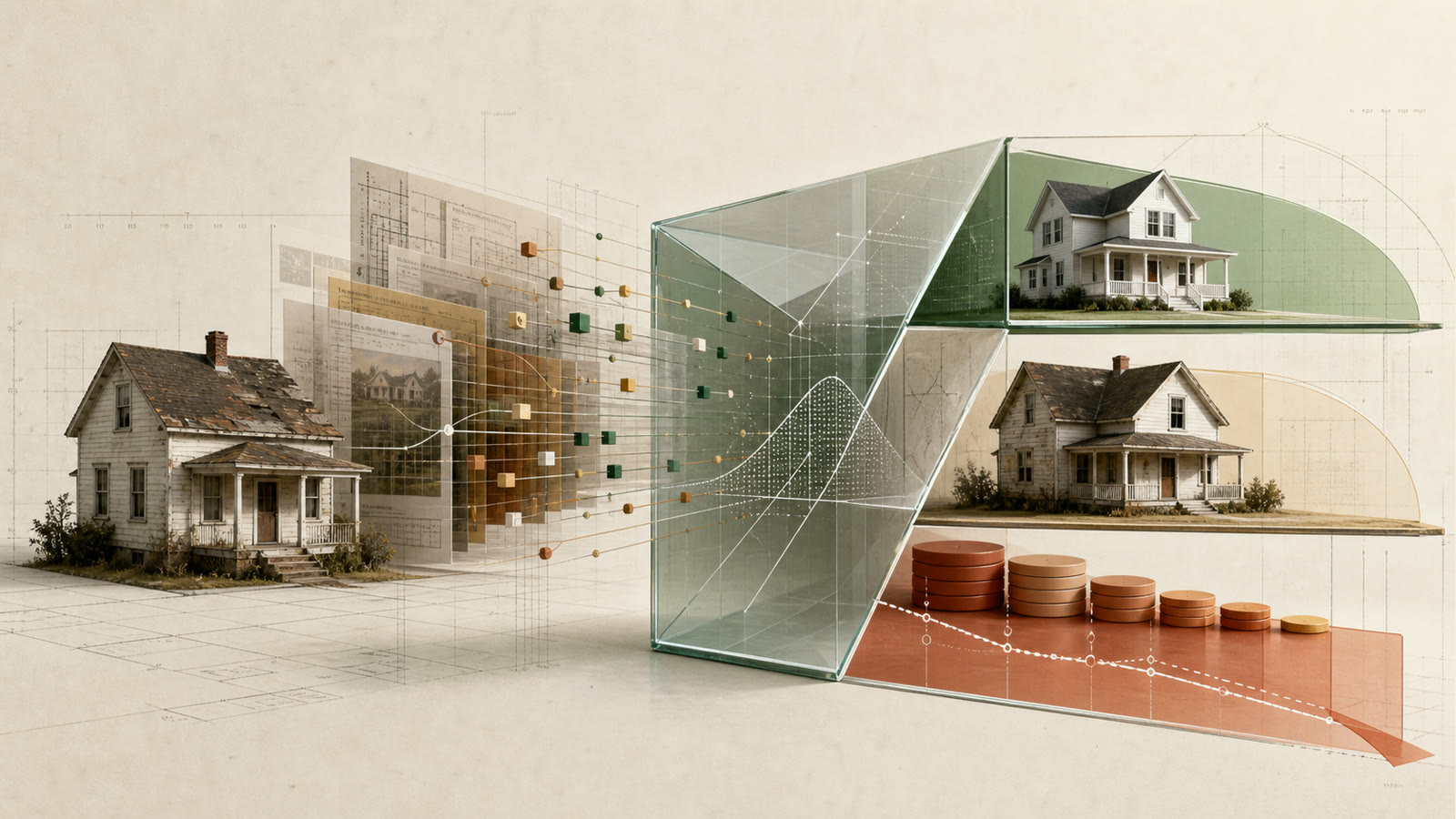
In practical terms, an AVM takes what is known about a subject property, compares it with relevant market evidence, applies a model, and returns an estimate.
The output may include:
- a single estimated value
- an estimated value range
- a confidence score or other uncertainty signal
- selected comparable properties
- factors that increased or reduced the estimate
Not every AVM uses artificial intelligence, and not every AI home-value tool is built the same way. Some AVMs rely mainly on statistical methods. Others use machine-learning models, comparable-sale logic, repeat-sales analysis, geographic features, or combinations of several approaches.
The label AVM describes the function, not one universal algorithm.
How Does an Automated Valuation Model Work?
Every provider has its own data, model, and quality controls, but a useful conceptual pipeline has five stages.
1. Identify the Subject Property
The model first needs a reliable property record.
Typical fields may include:
- address and parcel identity
- property type
- bedrooms and bathrooms
- living area
- lot size
- year built
- transaction history
- location coordinates
- recorded property characteristics
Errors at this stage propagate through the estimate. If the subject is attached housing but the record says detached single-family, or if the square footage is wrong, a sophisticated model can still produce the wrong answer.
2. Assemble Market Evidence
The system retrieves transactions and property records that may help explain value.
For a sales-comparison approach, the candidate pool may include recent nearby sales with similar physical characteristics. Other models may also use broader market trends, prior sales of the same property, geographic relationships, tax records, listing signals, or licensed third-party data.
More records do not automatically mean a better estimate.
The model needs relevant evidence, not merely a high comp count.
3. Filter, Rank, or Weight Comparable Properties
The candidate sales are not equally useful.
A valuation model may evaluate factors such as:
- distance from the subject
- sale date
- property type
- bedroom and bathroom count
- square-footage similarity
- lot and age differences
- neighborhood boundaries
- transaction type
- available condition signals
One recent renovated sale on the same block may be more informative for ARV than 20 older sales across a major road. Conversely, a nearby sale may be a poor comp if it is a different property type or reflects a non-typical transaction.
4. Estimate Value
The model converts the evidence into a point estimate or range.
Depending on the AVM, that could involve a statistical regression, comparable adjustments, price-per-square-foot logic, repeat-sales analysis, machine learning, an ensemble of several methods, or a fallback sequence that chooses the method best supported by the available data.
The estimate is the output of those inputs and assumptions. It is not a direct observation of the property's true value.
5. Report Confidence or Uncertainty
A responsible valuation product should communicate more than the headline number.
Confidence can reflect different things in different products, including the quantity and consistency of supporting data, the model's expected error, or how tightly multiple valuation methods agree. There is no universal confidence scale shared by every AVM provider.
That means a user should ask:
- What does this confidence label measure?
- Is it based on model precision, comp quality, coverage, or something else?
- Does a wide value range indicate unstable evidence?
- Can I inspect the properties supporting the estimate?
A confidence score is useful only when the user understands what it represents.
What Data Does a Real Estate AVM Use?
An AVM is only as good as the data available to it and the way that data is interpreted.
Common inputs can include:
| Data group | Examples | Why it matters |
|---|---|---|
| Subject property | Type, beds, baths, square footage, lot, year built | Defines what is being valued |
| Transactions | Sale price, sale date, prior transfers | Provides observed market evidence |
| Comparable properties | Similar nearby sales | Supports relative valuation |
| Location | Coordinates, neighborhood relationships, market area | Captures local price differences |
| Market conditions | Recent price movement, transaction volume, time effects | Helps account for changing markets |
| Condition signals | Renovation, distress, listing descriptions, user inputs | Separates physically different properties |
The final row is often the hardest.
Many important repairs and renovations do not appear cleanly in recorded property data. A new roof, failing HVAC system, foundation movement, dated kitchen, water damage, or high-quality renovation can materially change buyer behavior without appearing as a simple structured field.
That is why property data collection remains important even as valuation models improve. Fannie Mae describes subject-property data as a foundational input across appraisals, market analysis, automated valuation modeling, and quality control. Fannie Mae on standardized property data collection
AVM vs Appraisal vs CMA: What Is the Difference?
These terms are often treated as synonyms. They are not.
| Method | Who or what produces it | Typical strength | Typical limitation |
|---|---|---|---|
| AVM | Mathematical software model | Fast, scalable, consistent screening | Limited by model scope and available data |
| Appraisal | Credentialed real estate appraiser | Property-specific professional analysis under appraisal standards | Slower and more expensive than automation |
| CMA | Real estate professional | Local comp selection and market context | Quality varies with data access and analyst judgment |
| BPO | Real estate broker or agent | Practical local pricing opinion | Not the same product or standard as an appraisal |
An AVM is not automatically an appraisal. Freddie Mac disclosures describe an AVM as an estimate produced from a large database and mathematical algorithms, not a valuation prepared by a credentialed appraiser under USPAP. Freddie Mac property-valuation disclosure
The right method depends on the decision, risk, and transaction requirements.
An investor screening 100 leads needs speed. A lender making a covered mortgage decision has different obligations. A wholesaler standing inside a distressed house has condition evidence that may not exist in any database.
AVM Value Is Not the Same as ARV
This is the most important distinction for real estate investors.
Current Market Value
Current market value asks what the property may be worth in its present market context under the estimate's assumptions.
If the model does not know the actual condition, even the phrase "current value" needs scrutiny. A clean public record does not tell you whether the kitchen was removed last week.
After-Repair Value
After-repair value (ARV) asks what the property may sell for after a defined renovation is complete.
ARV therefore requires two separate judgments:
- What condition and finish level will exist after repairs?
- Which completed sales represent that future condition?
A general-purpose AVM may estimate market value without modeling a specific renovation plan. Calling that number ARV does not make it an after-repair analysis.
Investor Buy Price
Investor buy price asks what an end buyer can pay while their strategy still works.
For a flipper, that calculation may consider ARV, repairs, financing, holding costs, resale costs, contingency, and required profit. A landlord may focus on rent, operating expenses, financing, cash flow, and target return. A BRRRR buyer must also consider the refinance constraint.
That is why cash buyers can underwrite the same wholesale deal differently.
Maximum Allowable Offer
For a wholesaler, maximum allowable offer (MAO) is lower than the end buyer's price ceiling when the deal also needs room for an assignment fee and wholesaler-paid costs.
The simplified relationship is:
AVM or comp-supported value
        -> strategy-specific investor calculation
        -> end buyer price ceiling
        -> minus wholesale fee and wholesaler-paid costs
        -> maximum seller offer
An AVM provides an input near the beginning of that chain. It does not answer every step.
For the complete pricing logic, see our wholesale real estate MAO calculator guide.
Why Wholesaler Valuation Is Harder Than Estimating a Typical Home
Traditional valuation performs best when the subject resembles the properties around it and the relevant data is abundant.
Wholesale inventory is often difficult precisely because it is not typical.
The property may have:
- deferred maintenance that is not recorded
- partial renovation with inconsistent quality
- fire, water, foundation, or roof damage
- unusual square footage or room layout
- an addition with uncertain permit history
- tenant or occupancy complications
- few similar recent sales
- a neighborhood that changes block by block
The wholesaler is also asking a counterfactual question: what will this property be worth after work that has not happened yet?
That introduces a second model inside the valuation model: the repair and condition scenario.
If the future condition is vague, ARV will be vague no matter how precise the output looks.
How AI Changes Automated Property Valuation
AI can improve parts of the valuation workflow without changing the underlying need for evidence.
Potential uses include:
- ranking candidate comps by several dimensions at once
- identifying likely outliers or non-comparable transactions
- extracting condition signals from permitted data sources
- selecting among valuation methods based on coverage
- summarizing why the estimate moved
- explaining uncertainty in plain language
- letting users run alternative repair and value scenarios
The best role for AI is not to invent a more confident number. It is to help the user inspect the evidence and move through the workflow faster.
In Rehouzd, we deliberately separate the layers:
- sold comparables support ARV research
- rental comparables support rent analysis
- investor transactions show what cash buyers have paid
- rehab assumptions describe the work needed
- strategy-specific solvers calculate investor economics
- the user can review and change assumptions
That design prevents one generic "AI home value" from silently becoming rent, ARV, buyer price, and MAO at the same time.
It also aligns with our broader approach to keeping AI agents from hallucinating real estate data: models can help interpret and route, but the facts and financial calculations need explicit sources.
Where Automated Valuation Models Fail
AVMs do not fail only because the algorithm is weak. They fail when the model, data, property, or question do not line up.
The Property Is Unusual
A 4,000-square-foot house surrounded by 1,200-square-foot sales may have many nearby records and no truly comparable properties.
The Condition Is Wrong or Missing
Recorded facts can identify a three-bedroom house. They may not identify that it needs structural repairs, or that it has been fully renovated to a higher finish level than nearby properties.
The Market Changes Faster Than the Data
Closed sales are backward-looking. A rapidly changing interest-rate environment, sudden inventory shift, employer move, insurance shock, or local demand change can alter current buyer behavior before enough new transactions close.
Geographic Boundaries Matter
Distance is useful, but it is not the same as neighborhood similarity. A major road, school boundary, flood exposure, subdivision line, or abrupt block-level condition change can matter more than a quarter mile.
Transaction Types Are Mixed
Retail sales, distressed transfers, investor purchases, portfolio transactions, and non-arm's-length transfers do not answer the same valuation question. A model needs to classify and use them appropriately.
The User Asks the Wrong Number to Do Too Much
Even an accurate current-value estimate does not automatically support an ARV, rent estimate, flip price, landlord price, or seller offer.
This last failure is a product-design problem as much as a modeling problem.
How Accurate Are AVMs?
There is no responsible universal answer such as "AVMs are 95% accurate."
Accuracy depends on:
- the particular model
- the market and property type
- data freshness and coverage
- the target value being estimated
- the time between the estimate and observed sale
- how error is measured
- whether difficult properties with no estimate are included
Two accuracy claims can look comparable while using different definitions, geographies, test sets, and coverage rules.
When evaluating an automated property valuation, ask for more than a marketing percentage:
- What value is the model trying to estimate?
- What period and geography were tested?
- How is error measured?
- What percentage of properties receive an estimate?
- How does performance change for low-confidence outputs?
- Can the supporting comps be reviewed?
A system that declines to estimate an unusual property may show better reported accuracy than a system that attempts every address. Coverage and accuracy need to be considered together.
What Do AVM Confidence Scores Mean?
An AVM confidence score is a signal about the estimate's expected reliability or supporting evidence, as defined by that provider.
It is not a probability that the property will sell at the displayed value.
A lower-confidence result may reflect:
- too few relevant sales
- a wide spread among candidate comps
- greater distance or age of the evidence
- unusual subject-property characteristics
- disagreement among model methods
- weak or inconsistent source data
A high-confidence result still does not account for facts the system never received. If the roof collapsed yesterday, a high score based on last month's data cannot know that.
The right response to lower confidence is not always to reject the estimate. It is to widen the range, inspect the comps, verify condition, and add a larger risk buffer where appropriate.
A 10-Minute AVM Review for Wholesalers
Before using an automated value in an offer, work through this sequence.
1. Verify the Subject
Confirm property type, beds, baths, square footage, lot, year built, address, and unit count. If the subject facts are wrong, stop there.
2. Define the Value You Need
Write down whether you are estimating:
- current as-is value
- after-repair value
- market rent
- investor buy price
- maximum seller offer
Do not let those labels blur together.
3. Inspect the Best Comps
Look beyond the count. Check recency, distance, property type, size, condition, transaction type, and neighborhood boundaries.
4. Verify the Condition Scenario
Walk the property when possible. Review photos, disclosures, repair selections, inspection findings, and contractor input appropriate to the deal. Our AI rehab cost estimator guide explains how to treat automated repair numbers as reviewable assumptions rather than bids.
5. Stress-Test the Fragile Inputs
Run at least a conservative ARV and higher-rehab scenario. If a modest change destroys the assignment spread, the deal is not robust.
6. Check Actual Investor Behavior
Retail ARV tells you what a completed property may sell for. Investor transactions help show what cash buyers have paid in the area. Both matter, and they belong on separate lines.
7. Use the Buyer Strategy's Math
Run flip, rental, or BRRRR economics as appropriate. Do not use a generic percentage rule when financing, rent, or resale costs determine the buyer's ceiling.
AVM Quality-Control Rules: A Narrow but Important Note
Federal agencies adopted quality-control standards for AVMs used by mortgage originators and secondary-market issuers in certain covered credit and securitization decisions involving a consumer's principal dwelling. The final rule became effective October 1, 2025. It addresses confidence in estimates, protection against data manipulation, conflicts of interest, random sample testing and review, and applicable nondiscrimination requirements. FHFA final rule on AVM quality-control standards
That scope matters.
The rule does not mean every online investor estimate is an appraisal, and it should not be casually described as applying to every use of property-valuation software. Teams need to evaluate the actual product, user, transaction, and regulatory context with qualified counsel.
The broader engineering lesson still travels well: valuation systems need data controls, performance monitoring, testing, documentation, and processes for challenging bad outputs.
What a Useful Investor AVM Should Show
For wholesalers and real estate investors, the most useful experience is not a giant number with an AI badge.
It should show:
- the value being estimated
- the subject-property facts used
- relevant comparable sales
- condition assumptions
- confidence or uncertainty
- the ability to remove or replace weak comps
- a separate repair estimate
- strategy-specific buyer calculations
- conservative and aggressive scenarios
- what the model does not know
That is the difference between an estimate designed to impress and an analysis designed to be reviewed.
Rehouzd Dispo uses automation to compress property research, comp review, rehab assumptions, buyer-side pricing, and scenario analysis into one workflow. The goal is not to remove judgment. It is to put the assumptions close enough together that a wholesaler can see when they disagree.
Final Takeaway
An automated valuation model is a fast mathematical estimate of property value or a value range.
It is not automatically an appraisal. It is not automatically ARV. It is not the price a cash buyer can pay. It is not the maximum offer a wholesaler should make to a seller.
For ordinary properties with strong recent data, an AVM can be an efficient and useful first pass. For distressed, unusual, thinly traded, or rapidly changing properties, the estimate needs more scrutiny.
The best real estate AI does not hide that uncertainty. It helps users inspect the subject, comps, condition, confidence, and buyer strategy separately, then connects them through transparent calculations.
Use the AVM to get to the right questions faster. Do not let one automated number answer questions it was never designed to solve.
Frequently Asked Questions
What is an automated valuation model in real estate?
An automated valuation model, or AVM, is a computerized mathematical model that uses property and market data to estimate a property's value or value range. Depending on the product and use case, it may analyze property characteristics, transaction history, comparable sales, location, and market patterns.
Is an AVM the same as an appraisal?
No. An AVM is a model-generated estimate, while an appraisal is an opinion of value developed by a credentialed appraiser under professional standards. An AVM can support screening and quality control, but it does not automatically replace an appraisal, inspection, broker price opinion, or local professional judgment.
How accurate are automated valuation models?
AVM accuracy varies by model, market, property type, data quality, and the number of relevant recent sales. Estimates tend to deserve more confidence when the property is typical for its area and supported by close, recent, similar transactions. Unique properties, thin markets, unrecorded renovations, and rapidly changing neighborhoods create more uncertainty.
What is the difference between AVM value and ARV?
A general AVM usually estimates a property's current market value under its available data and assumptions. ARV means after-repair value: the expected market value after a defined renovation is completed. ARV therefore requires both credible comparable sales and an explicit view of the property's future condition.
Can wholesalers use an AVM to calculate MAO?
An AVM can provide a valuation input, but it does not produce a defensible maximum allowable offer by itself. MAO also depends on repair costs, buyer strategy, financing, holding and transaction costs, target return, risk allowance, and the wholesale fee. Those assumptions should be calculated separately and stress-tested.
Does AI make a real estate AVM more accurate?
AI can help identify patterns, rank comparable properties, process richer property signals, and explain why an estimate moved. It does not guarantee accuracy. Better model architecture cannot compensate for stale source data, an incorrect condition assumption, an unusual property, or the wrong valuation question.
Ready to put this into practice?
Price the property, review repairs, and find active buyers.Get instant ARV estimates, AI-powered rehab costs, and access to verified cash buyers in your market.