How We Keep AI Agents From Hallucinating Real Estate Data
A technical look at how grounded real estate AI agents use source-specific tool calls, deterministic underwriting, structured context, evals, and human review to reduce hallucinations.

Contents
Ask an AI agent what a property is worth and it can produce a confident answer in seconds.
Confidence is not evidence.
If the agent invents one comparable sale, mixes retail comps with investor purchases, or silently changes a rehab assumption, the rest of the analysis can look mathematically polished while being fundamentally wrong.
That is why our approach to AI agents for real estate starts with a hard boundary:
The model can reason, route, summarize, and explain. It does not get to invent the property facts or own the underwriting math.
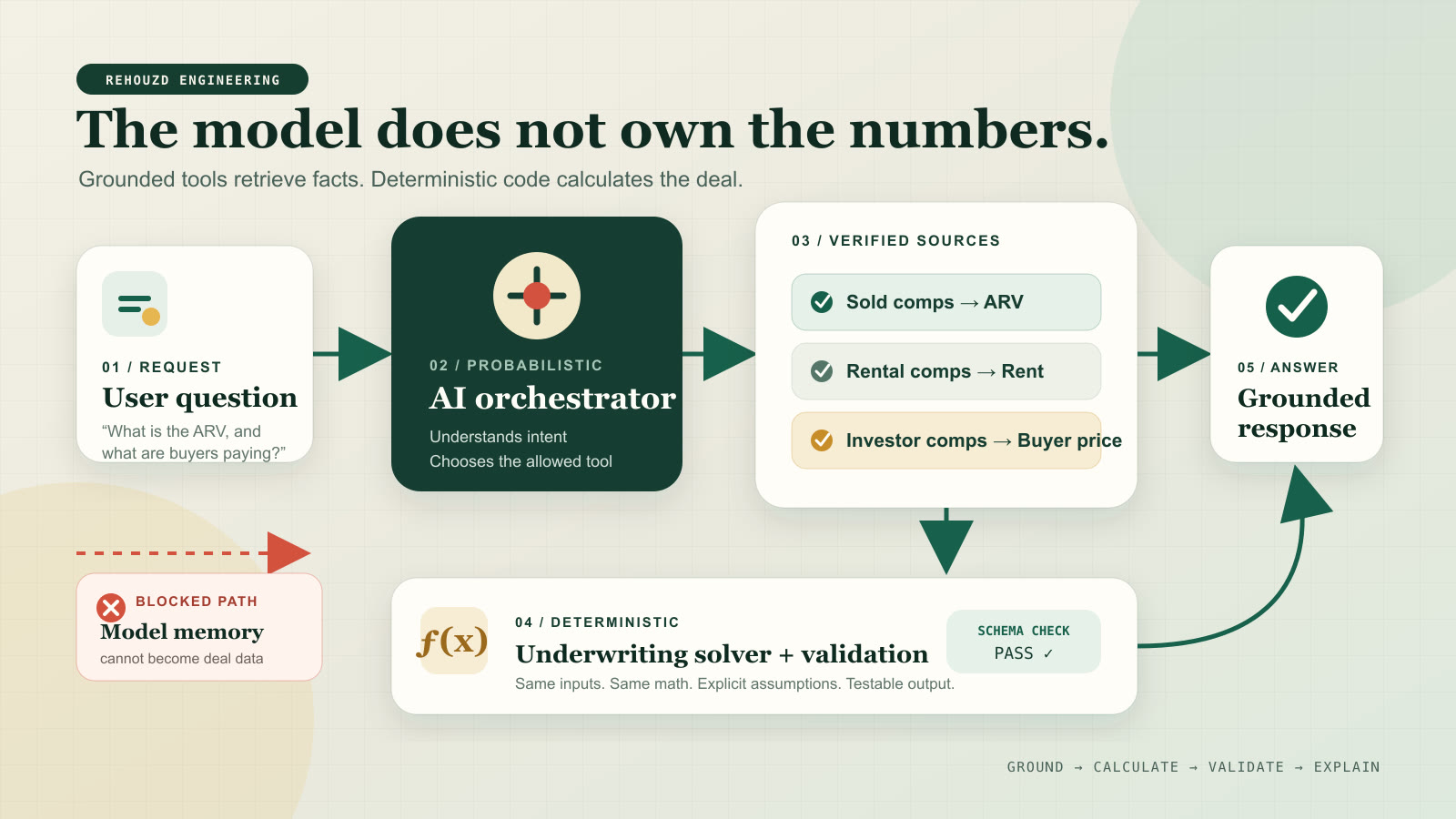
This article explains the architecture we use to reduce AI hallucinations in real estate workflows: grounded context, source-specific tool calls, deterministic financial solvers, structured outputs, explicit failure states, evals, and human review.
It does not eliminate risk. No serious team should promise that. It makes the system more constrained, testable, and auditable than a chatbot answering from model memory.
The Short Answer: How Do You Prevent AI Hallucinations in Real Estate?
You do not solve hallucinations with a better prompt alone.
You reduce them by designing the application so the model has fewer opportunities to create unsupported facts:
- Limit the agent to a specific real estate workflow.
- Load only the property and deal context relevant to the current request.
- Retrieve facts through typed, source-specific tools.
- Keep sold comps, rental comps, and investor comps separate.
- Run underwriting and scenario math in deterministic code.
- Make missing or failed data visible instead of filling the gap.
- Validate the response structure and important claims.
- Trace tool calls and test common failure cases with evals.
- Require a person to approve consequential actions.
The architecture is deliberately unglamorous. Reliability comes from constraints.
What Is an AI Hallucination?
An AI hallucination is content that sounds credible but is false, unsupported, internally inconsistent, or disconnected from the supplied evidence.
The more formal term used by the National Institute of Standards and Technology is confabulation. NIST describes it as generated content that is confidently presented even though it is erroneous or false, and warns that the risk is especially relevant in consequential decision-making. NIST AI 600-1: Generative Artificial Intelligence Profile
In a wholesale real estate workflow, a hallucination could be:
- a comparable sale that does not exist
- a real sale with the wrong price or closing date
- an investor purchase described as a renovated retail comp
- a rental listing used to justify after-repair value
- a buyer transaction attributed to the wrong entity
- a repair cost presented as verified when it was only assumed
- a maximum allowable offer calculated with a different profit target than the user selected
- a confident buyer-demand claim when no current buyer data was returned
These are not cosmetic errors. They can change what a wholesaler offers a seller, how a deal is positioned, which buyer receives it, and whether the assignment has enough margin to close.
The Three Failure Modes We Design Around
Most real estate AI errors fall into three practical categories.
1. Invented Facts
The model supplies a number, address, transaction, or property detail that is not in the available context.
This often happens because language models are optimized to produce a useful continuation, not to behave like a database with a mandatory null response. If the application rewards a complete answer but does not define a safe failure path, the model may fill the gap.
2. Source Confusion
The underlying records may be real, but they answer a different question.
Retail sold comps, rental comps, and investor purchases are all relevant to real estate. They are not interchangeable:
| User question | Correct evidence | What it supports |
|---|---|---|
| What could this property be worth after repairs? | Comparable retail sales | ARV research |
| What could this property rent for? | Comparable rental records | Rent estimate |
| What are cash buyers paying nearby? | Investor purchase activity | End-buyer price context |
An agent that blends those datasets into one generic bucket called "comps" can produce a well-written but misleading answer.
3. Arithmetic and Assumption Drift
The model begins with the right facts but changes the math while explaining them.
For example, the user may select a $35,000 rehab budget and a specific profit target. A conversational model might later run a scenario with $30,000 rehab, use a shorthand percentage rule, or omit a financing cost without clearly saying so.
The wording still sounds reasonable. The output is no longer the same deal.
Our Core Architecture: The Model Is an Orchestrator
The easiest mental model is to separate the system into two layers.
The probabilistic layer handles language and decisions:
- understand what the user is asking
- choose an allowed tool
- decide whether enough evidence exists
- explain a result in plain English
- suggest the next useful question
The deterministic layer owns facts and calculations:
- current property context
- comparable-sale records
- rental records
- investor purchase records
- user-selected assumptions
- underwriting formulas
- validation rules
That separation lets us use the part of an LLM that is genuinely valuable without pretending it is a ledger, county-record database, or financial calculator.
OpenAI's agent guidance describes agents as systems in which a model manages workflow execution and selects tools within defined guardrails. It also recommends layered guardrails and human intervention for higher-risk actions. A practical guide to building agents
The important word is system. The model is one component inside it.
Layer 1: Scope the Agent Before Grounding It
Grounding a model with more data does not help if the agent's job is undefined.
Our deal companion is scoped to real estate wholesale workflows. It can discuss deal analysis, ARV, rehab, margins, comparable sales, buyer activity, outreach, and pipeline questions. It is not intended to become a general assistant just because the chat box can accept any text.
That narrow scope gives us concrete rules:
- the agent works on the property currently open in the product
- it should not answer as though it has data for a different address
- it can only call tools exposed for the active workflow
- it must use supplied or retrieved numbers
- it must say when required evidence is unavailable
A narrow agent can still be useful. It is simply easier to test because "correct" behavior has a boundary.
Layer 2: Give Every Data Source a Specific Tool
One broad search_everything tool is convenient to build and difficult to trust.
We prefer tools with one clear purpose. In Rehouzd, the agent has separate paths for:
get_sold_compsfor the sales used to explain ARVget_rental_compsfor evidence behind a rent estimateget_investor_compsfor nearby investor purchase activityrun_deal_scenariofor an explicit change to ARV, rehab, or target profit
Each tool has a defined input shape, predictable result, and validation behavior. If sold comps are unavailable, the sold-comps tool returns that condition. It does not substitute rental records so the response looks complete.
This matters for both reliability and debugging.
If an answer is wrong, we can ask:
- Did the agent choose the correct tool?
- Did the tool receive valid parameters?
- Did the data source return the expected records?
- Did the model represent the returned evidence accurately?
Without source-specific tools, those failure points collapse into one opaque prompt.
Layer 3: Keep Underwriting Math Outside the Language Model
Financial calculations should be reproducible.
If the same ARV, rehab, holding period, financing assumptions, closing costs, and profit target enter the system twice, the underwriting result should not change because the model chose different wording.
That is why Rehouzd runs fix-and-flip, buy-and-hold, and BRRRR calculations through deterministic solvers. The model can request a scenario and explain the output, but application code computes the result.
The flow looks like this:
user asks a scenario question
        |
agent extracts explicit overrides
        |
schema validates the inputs
        |
deterministic solver calculates the scenario
        |
agent explains the returned numbers
This approach has four advantages:
- Repeatability: identical inputs produce identical outputs.
- Testability: formulas and edge cases can be covered by unit tests.
- Transparency: assumptions can be displayed next to the result.
- Change control: a formula update happens in versioned code, not through prompt drift.
This is also why a language model should not be trusted blindly for underwriting. Our earlier article, Why AI Is Great for Real Estate Research but Shouldn't Be Trusted Blindly for Underwriting, explains the user-facing version of that distinction.
The agent helps a person understand the deal. The solver protects the math.
Layer 4: Treat Missing Data as a Valid Result
Many hallucinations begin with a product decision: the interface expects an answer even when the evidence is incomplete.
We design for absence explicitly.
If a tool fails or returns no records, the correct behavior is not to approximate a number from memory. The agent should say what it could not retrieve, explain what is still known, and identify what the user can verify next.
Examples include:
- "I could not pull sold comps for this property right now."
- "There is not enough rental evidence in the current result to support a rent estimate."
- "I do not have investor activity for that buyer."
- "The rehab scope has not been selected, so the scenario is incomplete."
This can feel less magical than an instant answer. It is much more useful than confident fiction.
Layer 5: Structure Context and Outputs
Free-form text is flexible. It is also easy to misread.
We pass deal context as named fields instead of asking the model to infer a schema from a paragraph. Property facts, valuation inputs, strategy, buyer activity, and page context remain distinct. Large comp arrays can stay behind tools until the user actually asks for them.
The output side should be structured too. A production workflow may need fields such as:
- verdict
- evidence used
- assumptions
- missing data
- risk flags
- recommended next action
A schema cannot prove that every claim is true. It can ensure the application receives the fields it expects and can reject malformed output. OpenAI's Structured Outputs documentation describes strict schema adherence as a way to constrain output shape. Structured Outputs in the OpenAI API
That is an interface guarantee, not a factuality guarantee. You still need grounding and validation.
Layer 6: Test the Entire Workflow, Not Just the Final Answer
An agent can produce a bad result even when the final prose looks good.
The failure may have happened earlier:
- wrong intent classification
- wrong tool selected
- invalid parameter accepted
- stale context loaded
- source labels dropped
- missing result treated as success
- correct calculation explained incorrectly
That is why agent evals need to inspect the path, not only grade tone.
Useful real estate AI eval cases include:
- ARV question routes to sold comps, not investor comps
- rent question routes to rental comps
- buyer-price question routes to investor activity
- no comps produces an explicit limitation
- a different rehab amount triggers a new deterministic scenario
- the agent never creates a transaction for a buyer with no purchase history
- a property outside the active context is rejected or redirected
- a tool failure is visible in the answer
- a sensitive write or outbound message requires approval
OpenAI's eval tooling supports datasets, testing criteria, graders, and repeatable runs. OpenAI Evals API
The practical goal is not a perfect score. It is catching regressions before users do.
Layer 7: Keep Humans at the Decision Boundary
Grounded data and deterministic math can improve reliability. They do not make the agent the property inspector, title company, attorney, lender, or acquisitions manager.
A wholesaler still needs to verify:
- physical condition and repair scope
- title, liens, ownership, and contract status
- local rules and required disclosures
- access, occupancy, and seller representations
- actual buyer interest and proof of funds
- final transaction economics
The agent can compress the research and make assumptions easier to inspect. The person remains accountable for the decision.
The same principle applies to actions. Reading deal context is lower risk than changing a live record or contacting a buyer. Consequential actions should have a clear approval step and an audit trail.
A Concrete Example: "What Is the ARV, and What Are Buyers Paying?"
That sounds like one question. It requires two evidence paths.
Part 1: Explain ARV
The agent should retrieve the suggested sold comps used for after-repair-value research. It can summarize the sale prices, dates, distance, property characteristics, and why those records are relevant.
For a deeper look at how different buyers interpret comparable sales and deal economics, see How Cash Buyers Underwrite Wholesale Deals.
Part 2: Explain Buyer Pricing
The agent should retrieve investor purchase activity near the property. Those records help describe what cash buyers have paid; they should not be relabeled as renovated retail sales.
Part 3: Run the Deal Scenario
If the user changes the ARV or rehab assumption, the application validates those inputs and passes them to the appropriate deterministic solver. The model then explains the returned investor price, maximum offer, expected spread, or risk flags.
The resulting answer can say:
- which source supported each number
- which assumptions came from the user
- which outputs came from the solver
- what evidence is missing
That provenance is more important than making the answer sound certain.
Why RAG Alone Is Not Enough
Retrieval-augmented generation, usually shortened to RAG, gives a model external information at response time. It is useful, but it is often described as though retrieval automatically makes an answer true.
It does not.
A RAG system can still:
- retrieve an irrelevant record
- retrieve stale or low-quality data
- omit the best record
- combine incompatible sources
- misstate what a document says
- cite evidence that does not support the claim
- calculate the wrong result from correct inputs
For a real estate AI agent, retrieval needs source semantics. The system must know not only that a record exists, but whether it is a retail sale, rental, investor transaction, listing, estimate, or user-entered assumption.
RAG supplies context. Architecture determines how safely that context is used.
What We Still Do Not Claim
We do not claim that an AI response is infallible because it used a tool.
Tools can return stale, incomplete, or incorrect source data. A model can choose the wrong tool or mischaracterize a correct result. A deterministic formula can faithfully calculate the wrong business assumption. An eval suite can miss a new edge case.
The right claim is narrower:
Grounding, typed tools, deterministic math, validation, traces, and human review reduce the surface area for unsupported answers and make failures easier to find.
That is the standard we want for AI inside Rehouzd Dispo. The goal is not to make the model sound like the smartest person in the room. The goal is to help wholesalers inspect a deal faster without hiding where the numbers came from.
A Technical Checklist for Grounded Real Estate AI
If you are evaluating or building an AI real estate platform, ask these questions:
- Does the product show which property is in the active context?
- Are model-generated claims separated from retrieved facts?
- Do sold, rental, listing, and investor records have distinct labels?
- Can the agent say "data unavailable" without inventing a substitute?
- Are underwriting formulas implemented outside the prompt?
- Can users inspect and change assumptions?
- Are tool inputs validated?
- Are tool calls, failures, and outputs traceable?
- Do evals test incorrect routing and missing-data cases?
- Do outbound messages and record changes require review?
If the answer to most of those questions is no, the product may be a fluent chatbot wrapped around an opaque calculation.
Final Takeaway
The safest role for an AI agent in real estate is not "source of truth."
It is orchestrator of verified sources, deterministic calculations, and clear next steps.
That design is less impressive in a 20-second demo because the agent sometimes stops, exposes uncertainty, or asks for missing information. In a real deal, those are features.
The model should be excellent at language and workflow reasoning. Property facts should come from property data. Comps should come from the correct comp source. Underwriting should come from testable code. Final judgment should stay with the user.
That is how we are building grounded AI agents for real estate: not by trusting the model more, but by designing the system so it has less room to make things up.
Frequently Asked Questions
What is an AI hallucination in real estate?
An AI hallucination is a plausible-sounding but unsupported claim, such as an invented comparable sale, buyer transaction, rent figure, repair estimate, or underwriting assumption. In a real estate workflow, the risk is not only an incorrect sentence; it is a user making an offer or marketing decision from a number that was never verified.
How can real estate AI agents reduce hallucinations?
The strongest approach is layered: restrict the agent to a defined job, retrieve current property facts through typed tools, keep data sources separate, calculate financial outputs in deterministic code, expose missing data, validate outputs, run regression evals, and require human review for consequential actions.
Does retrieval-augmented generation eliminate AI hallucinations?
No. Retrieval can give a model better evidence, but the model can still retrieve the wrong source, misread a result, combine incompatible data, or make an unsupported claim. Retrieval needs tool routing, validation, source labeling, evals, and honest failure behavior around it.
Why should AI underwriting use deterministic math?
Underwriting formulas should produce the same output from the same inputs. Deterministic solvers make assumptions explicit, support repeatable sensitivity analysis, and can be unit tested. The language model can explain the result, but it should not invent the calculation path.
Can an AI agent safely underwrite a wholesale real estate deal?
An AI agent can assist with comp research, scenario analysis, and explanations when it is grounded in verified inputs and bounded by deterministic calculations. It should support professional judgment, not replace property inspection, title work, legal advice, or the wholesaler's final decision.
Ready to put this into practice?
Price the property, review repairs, and find active buyers.Get instant ARV estimates, AI-powered rehab costs, and access to verified cash buyers in your market.