Why Skip Tracing Alone Is Not Enough in 2026: How AI Is Changing Real Estate Lead Generation
Skip tracing still matters, but phone numbers are no longer the edge. In 2026, wholesalers need AI lead scoring, seller context, distress signals, follow-up automation, and buyer-demand feedback to turn raw owner data into real opportunities.

Contents
Skip tracing is not dead.
But the old edge is gone.
For years, wholesalers treated real estate skip tracing like the unlock. Pull a list, buy owner phone numbers, blast calls and texts, and wait for a motivated seller to raise their hand.
That worked better when fewer people had access to the same data.
In 2026, almost everyone can buy a list. Almost everyone can skip trace. Almost everyone can load records into a dialer, CRM, or SMS tool.
The bottleneck has moved.
The question is no longer:
Can you find the owner's phone number?
The better question is:
Can you tell which owner is worth contacting, what matters to them, when to follow up, and whether the deal can actually be sold?
That is where AI real estate lead generation changes the workflow.
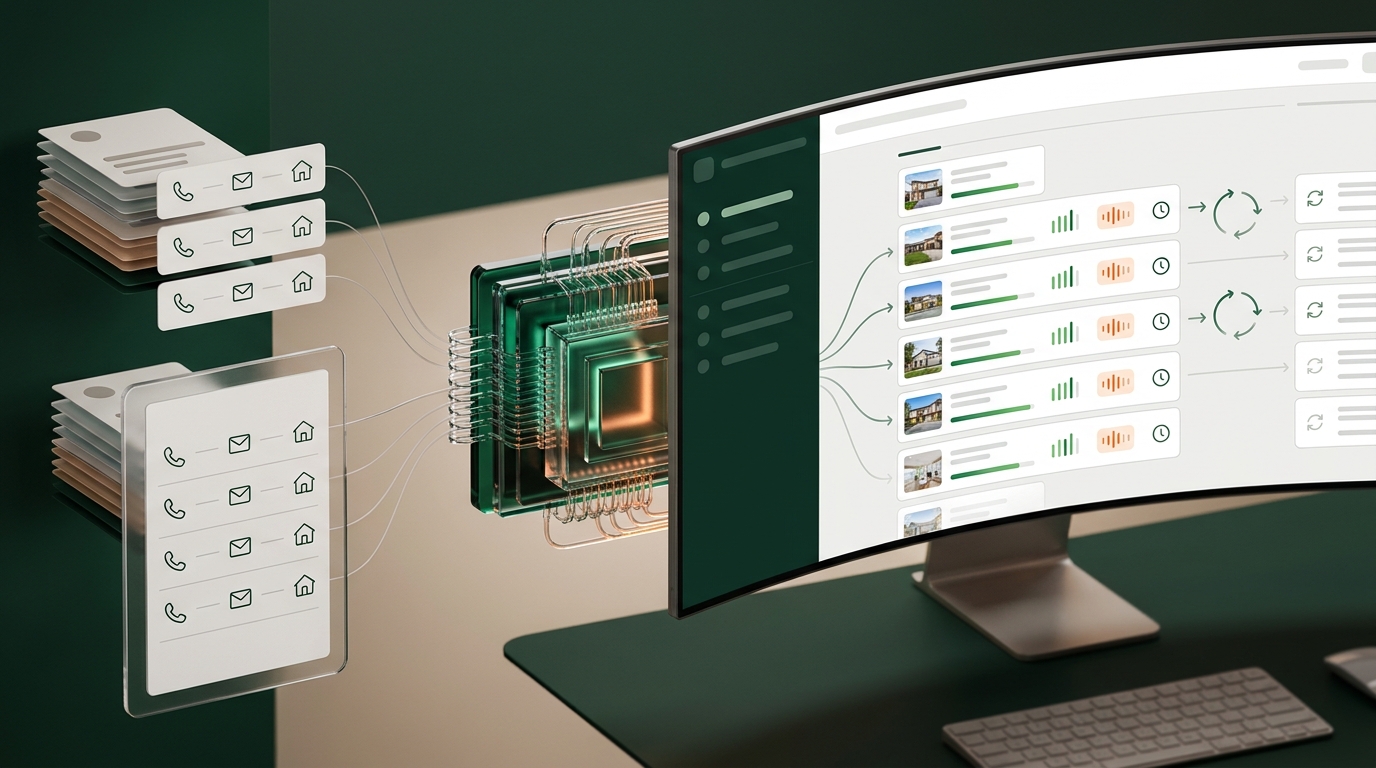
The Short Version
If you only want the takeaway, here it is:
- Skip tracing gives you contact data.
- Contact data does not tell you motivation.
- Motivation does not matter unless the deal can be priced and sold.
- AI helps organize signals, score leads, draft follow-up, and expose missing context.
- Human judgment still matters for seller trust, negotiation, compliance, and final offer decisions.
The winning workflow is not skip tracing versus AI.
It is skip tracing plus AI plus disciplined follow-up plus buyer-demand feedback.
That is the difference between a list and a lead generation system.
What Skip Tracing Actually Solves
Skip tracing solves a narrow but important problem:
Who can I contact, and how do I reach them?
For wholesalers, that usually means finding:
- mobile numbers
- landline numbers
- email addresses
- mailing addresses
- possible relatives or associated contacts
- owner identity when the mailing address does not match the property
That is useful.
You cannot work a lead if you cannot reach the owner.
But skip tracing does not answer the questions that decide whether the lead is worth your time:
- Does the owner have a real reason to sell?
- Is the property distressed or just old?
- Is there enough equity to make a cash offer possible?
- Is the owner local or absentee?
- Is the property in a ZIP code buyers actually want?
- Is this a rental, inherited property, vacant house, tired landlord situation, or something else?
- Has your team already contacted this person six times?
- If you get the contract, can you dispo it?
Those questions live outside the skip trace result.
That is why skip tracing real estate 2026 content needs to talk about more than phone-number accuracy.
The phone number is the entry point.
The system around it creates the deal flow.
Why Skip Tracing Became Commoditized
The first wave of wholesaling data tools gave operators a real advantage.
If you could pull absentee owners, tax-delinquent properties, pre-foreclosures, code violations, or tired rental portfolios faster than local competitors, you had a better shot at seller conversations.
Now that advantage is thinner.
More wholesalers are buying similar lists, using similar filters, and contacting the same owners. A seller with an obviously distressed property may hear from multiple investors in the same month.
That creates three problems:
1. The Same Owners Get Hammered
The more obvious the lead list, the more crowded it gets.
Absentee owner with equity? Everyone sees it.
Vacant property? Everyone sees it.
Tax-delinquent owner? Everyone sees it.
The lead may still be good, but the outreach environment is noisier. Generic messages get ignored faster.
2. Raw Lists Create False Confidence
A spreadsheet with 8,000 records feels productive.
It is not.
If the list is not prioritized, your team ends up spending the same effort on very different opportunities. A high-equity absentee owner with signs of deferred maintenance should not be treated the same as an owner-occupied property with no visible pressure and weak buyer demand.
The spreadsheet makes them look equal.
They are not equal.
3. Volume Hides Weak Follow-Up
A lot of wholesalers solve weak conversion by buying more data.
That usually makes the problem worse.
More records mean more first touches, more partial conversations, more missed callbacks, and more stale CRM notes. If follow-up is already broken, bigger lists just create more leakage.
This is where AI lead generation for wholesalers becomes practical.
Not because AI magically finds secret sellers.
Because AI helps you make better decisions with the data you already have.
What AI Adds on Top of Skip Tracing
AI does not replace skip tracing.
It adds an intelligence layer above it.
Think of the workflow like this:
| Layer | What it answers |
|---|---|
| Public records | Who owns the property? |
| List filters | Why might this owner be worth researching? |
| Skip tracing | How can we reach them? |
| AI enrichment | What does the property and owner context suggest? |
| AI scoring | Which leads deserve attention first? |
| Human review | What is the right offer, tone, and next move? |
| Dispo feedback | Will buyers actually want this deal? |
That middle layer is where the opportunity is.
Modern AI systems are useful because they can compress messy context into a structured first pass. Industry guidance on AI agents describes them as systems that use models and tools to perform workflows within guardrails, which is the right mental model for real estate lead automation too. A practical guide to building AI agents
For wholesalers, the best AI workflows are not "write me a cold text."
They are:
- score this seller lead
- summarize the property context
- identify missing data
- compare the lead against my buy box
- suggest the best follow-up angle
- flag compliance-sensitive outreach
- connect acquisition priority to buyer demand
That is much more valuable than another generic script.
AI Lead Scoring: The First Real Upgrade
The first upgrade is lead scoring.
A useful seller lead scoring system does not just ask, "Can we contact this owner?"
It asks:
- Is there a plausible motivation signal?
- Is there enough equity?
- Is the property likely distressed?
- Is the owner absentee, out of state, inherited, or holding multiple rentals?
- Is the property in an investor-friendly area?
- Are buyers active near this asset type and price band?
- Has this owner responded before?
- Is the lead cold, warm, stalled, or urgent?
AI can help turn those inputs into a ranked queue.
That matters because acquisitions teams do not have unlimited attention.
If a wholesaler has 1,000 skip-traced records, the operating question is not "Who should we contact eventually?"
It is:
Who should we call before lunch?
The best lead generation systems answer that question clearly.
AI Helps Find Motivation Signals, Not Just Contact Info
Motivation is rarely one datapoint.
It is usually a pattern.
A vacant property with tax pressure, out-of-state ownership, code complaints, and visible deferred maintenance is a different lead than a clean absentee-owned rental with stable ownership and no obvious distress.
AI can help connect those signals:
- ownership mismatch
- long hold period
- tax delinquency
- vacancy indicators
- code violations
- probate or inherited ownership clues
- old rental portfolio patterns
- repeated price cuts if the property was listed before
- weak condition signals from notes or images
- prior CRM interactions
That does not mean the seller is guaranteed to be motivated.
It means the lead deserves a different priority and a different conversation.
If you are building a Memphis-focused pipeline, this should sit on top of the fundamentals in our motivated seller guide for Memphis. The local context still matters. AI just helps you process it faster.
Better Outreach Starts With Better Context
Most seller outreach is too generic.
That is not only a conversion problem. It can also create brand and compliance risk.
The Federal Trade Commission continues to warn consumers about unwanted calls, texts, and deceptive outreach. FTC consumer advice on unwanted calls, emails, and texts
The FCC also maintains consumer complaint channels for robocalls, unwanted calls, and texts, which is a reminder that outreach volume without consent discipline can create real business risk. FCC consumer complaints
This is not legal advice. Wholesalers should work with counsel on TCPA, Do Not Call, consent, state rules, and local marketing compliance.
But from an operating standpoint, the direction is obvious:
Do not use AI to spam more people faster.
Use AI to make your outreach more selective, more relevant, and easier to review.
For example, a weak message says:
"Hi, I want to buy your house. Are you interested?"
A better workflow starts with context:
- Why is this owner in the queue?
- What do we know and not know?
- Is this a cold contact or prior conversation?
- What tone is appropriate?
- What should the rep verify first?
- Should this be a call, text, email, or mail piece?
AI can draft the message.
The system should decide whether the message is appropriate to send.
The human should approve risky or high-impact outreach.
AI Follow-Up Is Where the Money Is
Most wholesale leads do not convert on the first touch.
That is why follow-up matters more than list size.
The problem is that follow-up is operationally messy. Reps forget context. Notes are inconsistent. Callbacks get missed. A seller who was not ready 45 days ago may be ready now, but the CRM does not surface them at the right time.
AI can help by:
- summarizing every conversation
- extracting seller motivation, timeline, price expectation, and condition notes
- recommending the next follow-up date
- drafting the next message
- flagging stalled leads
- detecting when a lead should move from active follow-up to nurture
- briefing the rep before the next call
This pairs directly with the system we described in how to follow up with motivated sellers.
The point is not to automate empathy.
The point is to stop losing good leads because the system forgot what the seller already told you.
Buyer Demand Should Feed Back Into Lead Gen
This is the part many wholesalers miss.
Lead generation should not be separated from dispo.
If your buyers do not want the deal, the seller lead was not as valuable as it looked.
That is why skip tracing alone is incomplete. It may help you reach an owner, but it does not tell you whether the property will trade.
Before your team spends time chasing a seller, the system should ask:
- Are cash buyers active in this ZIP code?
- What property types are they buying?
- What price bands are moving?
- Is this likely a flip, rental, BRRRR, or wholetail opportunity?
- What assignment price would make the deal attractive?
- Does the buyer pool support the seller's likely expectation?
That is where Rehouzd can help connect acquisition and dispo.
If Rehouzd AI helps you understand the property and Rehouzd Dispo helps you understand buyer demand, your lead scoring gets sharper.
You are not just asking, "Can we get this owner on the phone?"
You are asking:
If this seller says yes, can we create a deal buyers actually want?
That is the question that protects your time.
The New Lead Gen Workflow for 2026
Here is the workflow I would use now:
1. Start With a Narrow List
Do not start with the biggest list you can afford.
Start with a focused list tied to a real buy box:
- ZIP codes you understand
- property types buyers want
- price bands that can trade
- ownership profiles that show potential motivation
- lead signals that are specific enough to act on
The tighter the starting list, the better the AI layer performs.
Bad inputs still create bad outputs.
2. Skip Trace, Then Clean the Data
Skip trace the list, but do not treat every returned number as equally useful.
Clean and structure the data:
- remove duplicates
- identify missing phone or email records
- separate mobile, landline, and email fields
- preserve source and confidence where available
- connect owner records back to property records
- keep prior CRM history attached
AI works better when the data model is clean.
3. Enrich the Lead With Context
Add property and owner context before scoring:
- assessed value
- estimated equity
- property age
- ownership duration
- absentee status
- rental indicators
- vacancy or condition clues
- tax or code pressure
- previous listing history when available
- local buyer demand
This is where the lead becomes more than a phone number.
4. Score the Lead
Use AI to create a first-pass score.
The score should explain itself:
- why the lead is high or low priority
- what signals support the score
- what data is missing
- what the rep should verify
- what outreach angle makes sense
- whether the deal appears dispo-friendly
Never use a black-box score without explanation.
If the system cannot explain the score, your team cannot trust it.
5. Route the Lead
Not every lead should get the same workflow.
High-priority leads should move into fast outreach.
Medium-priority leads may need research or lighter follow-up.
Low-priority leads may belong in nurture, direct mail, or no-contact.
The system should route effort based on expected value, not spreadsheet order.
6. Follow Up With Memory
Every interaction should update the lead profile.
If the seller says the roof is failing, that matters.
If the seller says they need to talk to a sibling, that matters.
If the seller says they are not ready until September, that matters.
AI can summarize and resurface that context so the next touch is not a reset.
That is how follow-up starts to feel like a relationship instead of a sequence.
7. Feed Dispo Results Back Into Acquisition
After deals are marketed, use the results.
If buyers ignore a certain area, condition, or price band, that should change lead scoring.
If buyers move quickly on a certain asset type, that should increase acquisition priority.
This is the loop:
Lead gen informs deals.
Deals inform dispo.
Dispo informs lead gen.
That feedback loop is the real AI advantage.
What AI Should Not Do
AI should not become an excuse for sloppy operations.
Do not use AI to:
- invent seller motivation
- ignore outreach compliance
- blast every number without review
- make legal claims
- hide missing data
- override local market knowledge
- treat a score as a guaranteed deal
- replace human negotiation
AI is strongest when it compresses research and improves prioritization.
It is weakest when operators use it to automate bad assumptions at a larger scale.
The Practical Stack
A modern wholesaling lead gen stack should have five layers:
- Lead sources: public records, tax lists, probate, code violations, absentee owners, tired rentals, referrals, inbound.
- Skip tracing and data hygiene: contact matching, duplicate cleanup, confidence tracking, CRM sync.
- AI scoring and enrichment: motivation signals, property context, missing data, suggested next action.
- Follow-up workflow: rep briefing, call notes, message drafts, next-touch timing, nurture routing.
- Buyer-demand feedback: deal analysis, cash buyer fit, dispo readiness, price sensitivity.
Most teams over-invest in layer two and under-invest in layers three through five.
That is why they have data but not momentum.
Final Thought
Skip tracing is still part of the game.
It is just not the whole game anymore.
In 2026, the wholesalers who win will not be the ones with the biggest spreadsheets. They will be the ones with the cleanest signal, the fastest follow-up, the best buyer-demand feedback, and the discipline to let AI assist without letting it run wild.
Use skip tracing to find the owner.
Use AI to decide what the owner record means.
Use human judgment to earn the conversation.
Use buyer demand to decide whether the opportunity is worth chasing.
That is the modern AI real estate lead generation workflow.
Frequently Asked Questions
Is skip tracing still worth it for real estate wholesalers in 2026?
Yes, but skip tracing by itself is no longer enough. It can help you find phone numbers, emails, and owner contact data, but wholesalers still need better lead selection, seller context, AI scoring, compliant outreach, and follow-up systems to convert that data into contracts.
How is AI changing real estate lead generation?
AI is helping wholesalers prioritize leads, summarize property and owner context, identify distress signals, draft more relevant outreach, schedule follow-up, and connect acquisition activity to buyer demand. The advantage is not just more data; it is better decisioning on which leads deserve attention now.
Can AI replace skip tracing?
No. AI does not replace the need for accurate contact data. It sits on top of skip tracing, public records, property data, CRM history, and buyer activity to help wholesalers decide who to contact, what to say, when to follow up, and what to verify before making an offer.
What is the best AI lead generation workflow for wholesalers?
Start with a focused lead list, skip trace it, enrich it with property and ownership context, score it with AI, route high-intent sellers into fast outreach, move lower-intent owners into nurture, and use buyer demand from tools like Rehouzd Dispo to avoid locking up deals that are hard to sell.
Ready to put this into practice?
Price the property, review repairs, and find active buyers.Get instant ARV estimates, AI-powered rehab costs, and access to verified cash buyers in your market.