Memphis Wholesale Real Estate in 2026: Best Zip Codes, Cash Buyer Demand, and What Actually Sells
Memphis wholesale real estate still has strong investor demand in 2026, but the market is more selective. Here are the ZIP codes, buyer patterns, and pricing rules wholesalers need to understand before they lock up a deal.

Contents
Memphis is still one of the most useful markets in the country for wholesalers to study.
It has affordable price points, older housing stock, active landlords, strong rental demand in the right pockets, and enough distressed inventory to create real opportunities for operators who know how to price a deal.
But Memphis wholesale real estate in 2026 is not a market where you can blast a deal at a random number and expect cash buyers to save you.
The market is more selective now.
Inventory has opened up. Homes are sitting longer. Buyers have choices. That does not kill wholesale deals. It just changes which deals move.
If you are trying to wholesale houses in Memphis TN this year, the question is not, "Is Memphis good?"
The better question is:
Which ZIP code, which buyer type, and which price point make this deal tradeable?
That is the whole game.
The Short Version
If you only want the operating read, here it is:
- Memphis still works for wholesalers, but buyers are more price-sensitive.
- ZIP code matters more than citywide comps.
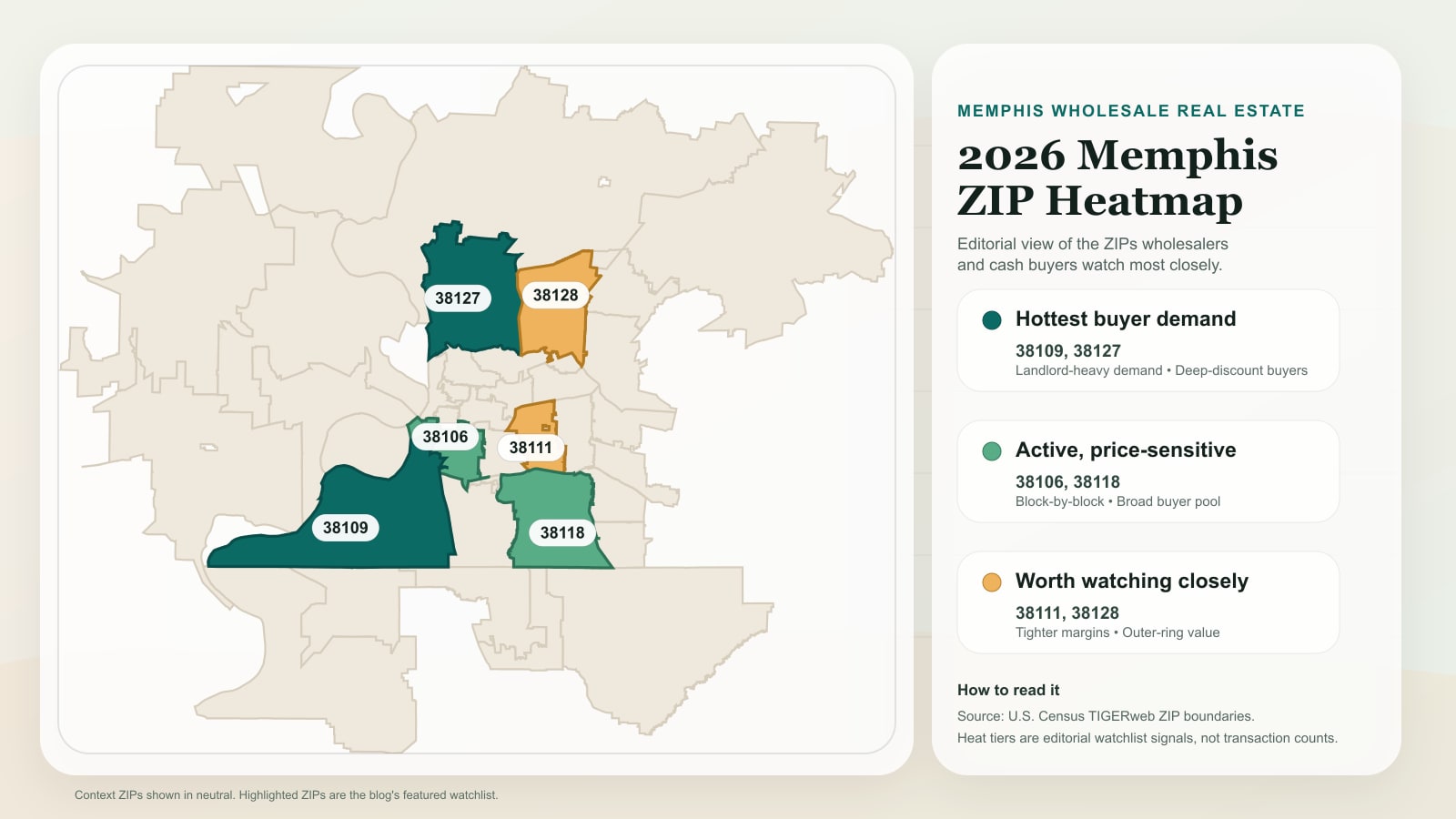
38109,38127, and38118are worth watching for landlord and value-add buyer demand.38106,38111, and38128can work, but they require more careful block-by-block underwriting.- Cash buyers in Memphis TN want clean numbers, clear photos, and a price that already accounts for rehab risk.
- In 2026, the best Memphis off market properties are not just cheap. They are priced to match the buyer pool that actually buys in that ZIP.
This is a market where the spread matters, but so does the story behind the spread.
What the 2026 Memphis Market Is Telling Wholesalers
Different data sources measure Memphis slightly differently, but the signal is consistent:
Buyers have more leverage than they did in tighter inventory markets.
The Memphis Area Association of REALTORS reported that April 2026 Memphis-area sales were down 5.0% year over year, while inventory rose 6.3% to 4,689 listed units. The same report showed a median sales price of $220,500 and average days on market of 60. MAAR
Realtor.com reported an even sharper city-level inventory signal for April: active listings up 31.6% year over year, a $170,000 median list price, and 59 days on market. Realtor.com
Redfin's March 2026 city data showed a $210,000 median sale price, 58 median days on market, and fewer homes sold than the year before. Redfin
That mix matters for wholesalers.
It means there is still activity, but buyers are not desperate. They can compare your assignment against MLS options, bank-owned properties, direct-to-seller leads, turnkey inventory, and other wholesalers.
That is why your deal package has to answer the buyer's real question:
Why should I buy this deal instead of the other Memphis investment properties I can already see?
Memphis Is Not One Market
The biggest beginner mistake in Memphis is treating the whole city like one comp set.
That is how wholesalers overprice deals.
A renovated sale in one pocket can be useless for a tired rental three miles away. A landlord-heavy ZIP can support one set of assumptions while a retail-flip pocket requires a totally different exit. Even within the same ZIP, a house can move from solid rental demand to "hard pass" based on a few blocks, a school boundary, a major road, or nearby boarded inventory.
So when someone says "Memphis ARV," slow down.
Ask:
- Which ZIP code?
- Which submarket inside that ZIP?
- What buyer strategy works there?
- Are nearby cash buyers flipping, renting, BRRRRing, or buying only at deep discount?
- Are the best comps renovated owner-occupant sales or actual investor exits?
That is where a citywide average becomes dangerous.
The best Memphis wholesalers do not sell the city. They sell a specific buyer thesis.
Best ZIP Codes in Memphis for Wholesale Investors to Watch
This is not a universal ranking. It is a wholesaler's operating watchlist based on the kind of buyer demand that tends to matter for assignments: price point, rental logic, value-add inventory, and whether cash buyers already understand the area.
Use it as a starting point, not as permission to skip comps.
38109: Landlord-Heavy, Spread-Driven Deals
38109 wholesale real estate is often about value and rental math.
This is a ZIP where many buyers are not looking for a pretty retail flip. They are looking for a price that makes sense after repairs, tenant risk, and long-term hold assumptions.
What tends to work:
- tired single-family homes with a believable rehab number
- landlord-ready rentals at the right basis
- deeper discounts where the buyer can absorb heavier condition risk
- clean title and simple access
What gets punished:
- retail-style ARV assumptions
- rehab estimates that ignore mechanicals
- vague photos
- assignment fees that leave no room for the landlord's margin
If you are marketing wholesale houses in Memphis TN in 38109, do not lead with hype. Lead with yield logic, nearby rental activity, and conservative pricing.
38127: Deep-Discount Buyer Demand
38127 cash buyers are usually underwriting hard.
That is not a bad thing. It means there can be real demand, but the buyer pool often expects a discount that reflects condition, tenant quality, insurance risk, taxes, holding time, and neighborhood variance.
This is not the ZIP where you can hide behind a thin comp set.
What tends to work:
- low-basis rentals
- distressed inventory with enough spread to justify risk
- deals with clear access and honest condition notes
- buyer lists segmented toward landlords and deep-discount operators
What gets punished:
- pretending every house is a flip
- using the nicest nearby sale as ARV without explaining the gap
- ignoring vacancy, vandalism, or security risk
- marketing to generic cash buyers instead of ZIP-specific operators
In 38127, the buyer is usually asking, "Can I own this low enough to survive the unknowns?"
Your price has to answer that.
38118: Broad Buyer Pool, Still Price-Sensitive
38118 investment properties can attract a broader mix of buyers because the ZIP has several different deal types.
You may see rental buyers, wholetail buyers, light-flip buyers, and BRRRR buyers looking at the same general geography, but not at the same price.
That is where wholesalers get into trouble.
A landlord may underwrite around rent and capex. A wholetail buyer may care more about cleanup, paint, flooring, and resale liquidity. A BRRRR buyer may need the refinance appraisal to support the plan.
What tends to work:
- clean rental opportunities
- light-to-moderate rehab deals
- properties with nearby investor comps and realistic resale bands
- deal packages that separate landlord math from flip math
What gets punished:
- one-size-fits-all pricing
- overestimating ARV from better-condition comps
- ignoring buyer strategy
- marketing only the upside and not the actual repair path
If a property in 38118 can work for more than one buyer type, say that clearly. Then show the numbers each buyer would care about.
38106: Block-by-Block Underwriting
38106 can work, but this is where block-level judgment matters.
Do not underwrite the ZIP. Underwrite the street.
In some pockets, a low-basis rental can make sense. In others, the buyer pool gets much thinner. Your comps need to be close, recent, and honest about condition.
What tends to work:
- true discounts
- buyers already active nearby
- clear repair scope
- realistic rental or resale assumptions
What gets punished:
- stretching across neighborhood breaks
- using old comps to justify today's price
- ignoring boarded houses or low-quality nearby inventory
- assuming a buyer will "see the vision" without proof
This is where Rehouzd's buyer-side workflow matters. A deal that looks fine in a spreadsheet can become weak once you see whether real buyers have actually purchased nearby.
38111: More Selective, Tighter Margins
38111 can have stronger retail and owner-occupant context in certain pockets, which can make the top-line ARV look attractive.
But that does not automatically make it easier to wholesale.
When the retail value is higher, sellers often want more. When sellers want more, the spread gets thinner. When the spread gets thinner, cash buyers become picky about rehab scope, finish level, and resale confidence.
What tends to work:
- cleaner properties with lighter rehab
- wholetail or cosmetic-flip opportunities
- deals where the seller discount is real, not imaginary
- tight comp selection with condition matching
What gets punished:
- assuming retail strength creates wholesale margin
- underestimating finish expectations
- ignoring holding costs
- trying to sell a thin deal to a hard-money flipper
In 38111, the wholesaler has to be disciplined. A good neighborhood does not fix bad basis.
38128: Outer-Ring Value, Buyer-Specific Fit
38128 is worth watching because it can offer more affordable entry points than stronger retail pockets while still giving buyers a familiar Memphis geography.
But the buyer type matters.
Some investors may see rental value. Others may look for wholetail potential. Others may avoid anything with too much rehab because the margin is not wide enough for the risk.
What tends to work:
- livable houses needing cosmetic or moderate repairs
- clear rental comps
- affordable price points with simple exit paths
- deals where buyers can move quickly without overthinking the story
What gets punished:
- heavy rehabs with thin margins
- vague ARV support
- pricing based on hope instead of buyer activity
- assuming all suburban-feeling inventory trades the same
This is a ZIP where you want to know your buyer before you lock the deal.
What Actually Sells to Memphis Cash Buyers
Cash buyers in Memphis do not buy "potential."
They buy numbers that survive inspection.
The deals that move usually have five things:
- A believable ARV based on close, relevant comps.
- A rehab estimate that matches the property condition.
- A price that already accounts for the buyer's risk.
- A clear exit strategy for that ZIP.
- Enough spread after your assignment fee.
That sounds obvious, but most failed wholesale deals fail on one of those five points.
The most common issue is not that the deal has no value. It is that the wholesaler priced it for the wrong buyer.
A landlord, flipper, BRRRR buyer, and wholetail buyer can all look at the same property and come up with different max allowable offers. If you only run one generic formula, you may miss the actual buyer that can close.
That is why you should read how cash buyers underwrite wholesale deals before you market in Memphis. The local buyer's math matters more than your preferred assignment fee.
How to Find Cash Buyers in Memphis TN
If you are building a Memphis buyer list, do not start with a random Facebook blast.
Start with proof of activity.
Look for:
- recent cash purchases in the target ZIP
- repeat LLC buyers
- landlords with multiple rentals nearby
- buyers who purchased similar condition inventory
- buyers active in the same price band
- buyers whose exit strategy matches your deal
Then segment them.
Your Memphis cash buyer list should not be one big bucket. It should tell you who buys:
38109rentals38127deep-discount deals38118light rehabs38111cosmetic flips or wholetails- South Memphis rental inventory
- North Memphis value-add inventory
That segmentation is the difference between marketing a deal and just sending noise.
If you need the full dispo workflow, read How to Market a Wholesale Deal to Cash Buyers. The same rules apply in Memphis, but the ZIP-specific buyer match matters even more.
How to Price Memphis Off Market Properties
In a more selective market, the right price is not just below ARV.
The right price is the number where a real buyer can say yes quickly.
For Memphis off market properties, use this order:
- Start with close sold comps.
- Remove comps that cross obvious neighborhood or condition breaks.
- Estimate rehab conservatively.
- Decide which buyer type is most likely to buy.
- Price backward from that buyer's exit.
- Check whether the assignment still leaves room.
If the deal only works when you assume the highest ARV, lowest rehab, fastest sale, and most aggressive buyer, it probably is not a deal.
Memphis rewards conservative underwriting because many properties are older and condition variance is real. Roof, HVAC, foundation, electrical, plumbing, and tenant issues can move a deal from profitable to painful fast.
That is also why AI real estate research should not replace underwriting judgment. AI can speed up comping and first-pass rehab logic, but local buyer demand and condition risk still need human review.
Where Rehouzd Fits
Rehouzd is built for exactly this kind of market.
Memphis is not a place where a single citywide number is enough. You need:
- ARV support
- rehab assumptions
- deal-quality checks
- buyer activity
- tradeability signals
- a clean deal package
- a real dispo process
That is why Rehouzd Dispo and the buyer workflow are useful for Memphis wholesalers. The goal is not just to estimate a property. The goal is to understand whether a buyer is likely to trade on it.
In practice, that means:
- pricing the deal against the right ZIP
- checking whether the comp set is strong or weak
- identifying which buyer strategy fits
- packaging the deal clearly
- ranking cash buyers based on fit
- sending outreach with enough detail for buyers to respond
If your workflow stops at ARV, you are still guessing.
If your workflow connects ARV, rehab, buyer demand, and dispo, you have a much better shot at locking the right deals and avoiding the ones that sit.
Data Note on the Heatmap
The heatmap in this post uses real ZIP Code Tabulation Area boundaries from the U.S. Census TIGERweb service. The ZIP tiers are editorial watchlist tiers, not a claim that Census or MLS data ranks those ZIPs by investor activity. Census TIGERweb
That distinction matters.
The point of the map is to show where a Memphis wholesaler might start researching buyer demand, not to replace deal-level underwriting.
Final Thought
Memphis still makes sense for wholesalers in 2026.
But it is not forgiving lazy pricing.
The best Memphis wholesale real estate deals are not just the cheapest houses. They are the deals where the ZIP, buyer type, rehab scope, and price all line up.
If you can do that, Memphis gives you something a lot of markets do not: enough affordability, enough investor attention, and enough property variance to create real wholesale opportunities.
If you cannot do that, the market will tell you fast.
Your buyers just will not respond.
Frequently Asked Questions
Is Memphis a good market for wholesale real estate in 2026?
Yes, Memphis can still be a strong wholesale real estate market in 2026 because price points are affordable, cash buyers are active, and rental demand supports landlord activity. But the market is more selective than it was during faster cycles, so wholesalers need tight pricing, clean photos, and buyer-specific deal math.
What are the best ZIP codes for Memphis wholesale real estate?
For wholesalers, 38109, 38127, and 38118 are useful ZIP codes to study because they tend to attract landlord, rental, and value-add investor attention. 38106, 38111, and 38128 can also work, but they require more careful block-by-block analysis and stronger comp discipline.
How do I find cash buyers in Memphis TN?
Start with recent cash transactions, investor-owned properties, landlord LLCs, active rental operators, and repeat buyers in the ZIP code where your deal sits. Then segment buyers by strategy: flipper, landlord, BRRRR buyer, wholetail buyer, or deep-discount buyer.
What makes a Memphis wholesale deal sell?
A Memphis wholesale deal sells when the price matches the buyer type, the rehab number is believable, the comps are close, the property condition is clear, and the spread survives conservative assumptions. In slower or more inventory-heavy markets, buyers punish vague deal packages quickly.
Ready to put this into practice?
Price the property, review repairs, and find active buyers.Get instant ARV estimates, AI-powered rehab costs, and access to verified cash buyers in your market.